Model · speech-to-text
Hebrish (Jachnun v1.0): Parakeet TDT 0.6B v2 for English–Hebrew code-switching
Speech-to-text that gets the Hebrew words right when an English speaker in Israel drops them into English: "pick up some bamba from the makolet".
Which model? Jachnun is for English with Hebrew words mixed in. For plain English and tech dictation with no Hebrew, use its sister model Boxty, which has none of the code-switching vocabulary. See Boxty →
What it fixes
I want to go to the Micollette today to buy my groceries.
I want to go to the makolet today to buy my groceries.
About the model
Hebrish is on-device English dictation for English speakers in Israel that writes the Hebrew words correctly, romanized: makolet, teudat zehut. It is a fine-tune of NVIDIA Parakeet TDT 0.6B v2, trained on my own recordings, and you use it through the Hebrish apps: an Android voice keyboard plus tray apps for Ubuntu and Windows. The project site is hebrish.app.
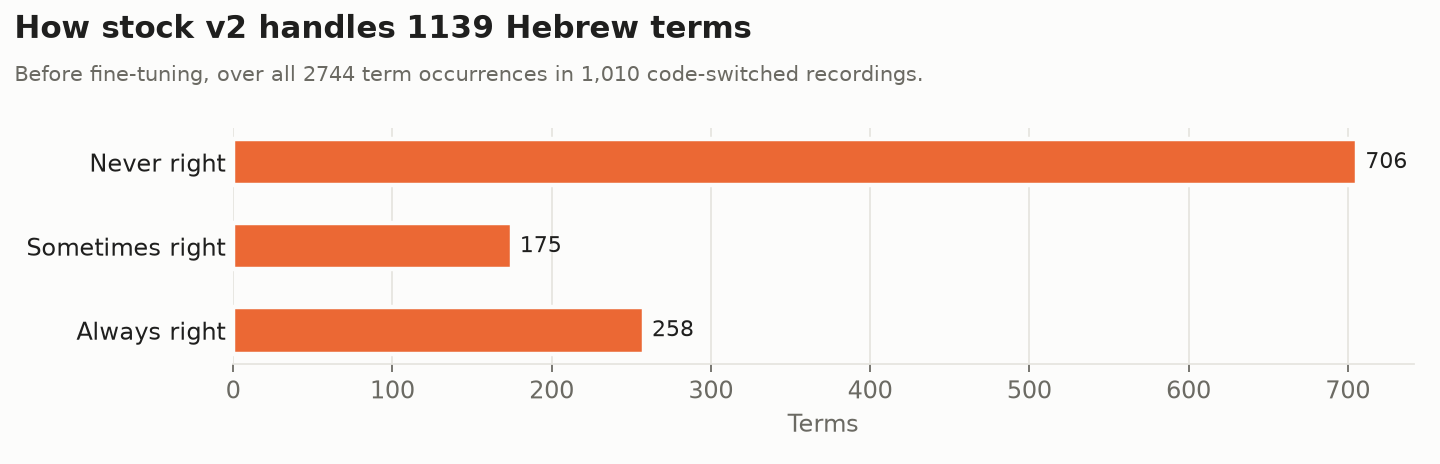
Stock Parakeet v2 is very good at English, but it has never seen romanized Hebrew. A Hebrew word in English speech comes out as whatever English words sound closest. The v2 tokenizer has no Hebrew characters, so this fine-tune teaches the model one romanized spelling for each Hebrew word.
It was trained on read-aloud sentences that I recorded on the Android phone that runs the model, plus some plain English so that it keeps its English. It runs fully offline on a phone or a Linux or Windows desktop.
This is v1.0 of the fine-tune, named Jachnun (2026-10-19), trained from stock Parakeet v2 on 339 minutes of code-switched speech. The five checkpoints published before it as v1 to v5 are now called PoC-1 to PoC-5. The code-switching line takes Israeli food names.
Since 2026-10-21 the Hebrish apps recommend Sabich v1.0, trained on the same code-switching data plus tech vocabulary and the other task recordings. It is level with Jachnun on code-switching and slightly better on tech terms; Jachnun stays in the apps as the pure code-switching model. See Sabich's own card page.
I chose v2 over Parakeet v3 on purpose. In my own dictation v2 was more accurate for English; v3 adds 25 languages and gives up some English accuracy.
The app: Hebrish
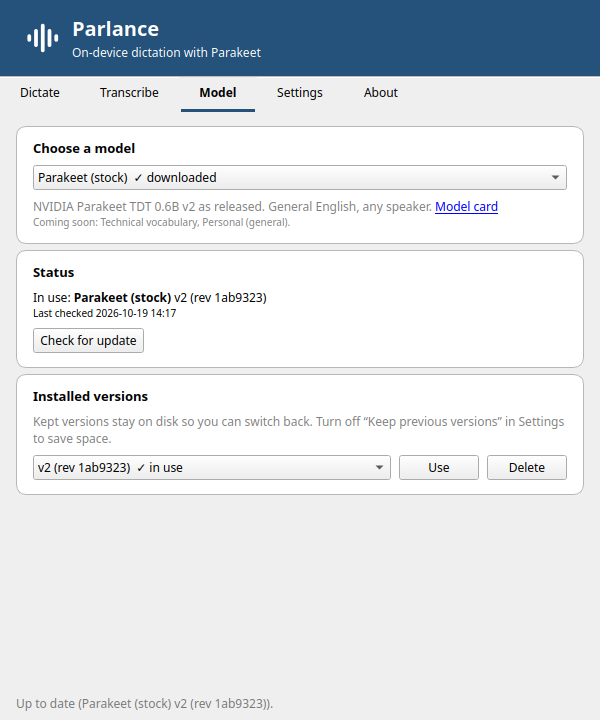
The Hebrish apps: an Android voice keyboard and tray apps for Ubuntu and Windows, running this fine-tune on-device. They download the model once (about 660 MB), check for newer releases, and transcribe fully offline. On the desktop, press F14 to dictate, or use the Transcribe tab to record or open an audio file and edit the transcript. Source and every release: github.com/Hebrish-ASR/Hebrish-App.
Linux (Debian / Ubuntu) about 11 MB + 660 MB model
Install with sudo apt install ./hebrish_*_amd64.deb (the file you downloaded). Ubuntu 26.04, amd64.
Download .deb, latest version →Android about 15 MB + 660 MB model
arm64 phones, Android 9+. Works as the voice input behind HeliBoard's mic key, or try it straight away in the app's own notepad. Also on the Hebrish F-Droid repository, which keeps it updated.
Download APK, latest version →Windows about 69 MB + 660 MB model
Unzip and run Hebrish.exe. Not yet tested on real hardware, and unsigned, so SmartScreen may warn.
Download .zip, latest version →Which file should I download?
If unsure, take Q8_0. On desktop CPUs it was also faster than Q4_K_M (about 3× realtime against 1.4× on 8 cores), and both gave the same transcripts as the full model on the test clips.
Hebrish APK 14.5 MB + 660 MB model
The Hebrish Android voice keyboard (latest version). Downloads the model once, then runs fully offline. arm64 phones, Android 9+.
Run with HeliBoard (its mic key opens it) Download Hebrish APK →GGUF Q8_0 730 MB
Android phone or Linux desktop. Take this one if unsure.
Run with Offline Voice Input (Android) / Handy (Linux) Download GGUF Q8_0 →GGUF Q4_K_M 475 MB
Phones with 4 GB of RAM or less, or if Q8_0 is too slow.
Run with Offline Voice Input Download GGUF Q4_K_M →.nemo checkpoint 2.47 GB
Python, GPU inference or further fine-tuning, at full precision.
Run with NVIDIA NeMo Download .nemo checkpoint →On Android
- Easiest: install the Hebrish APK and pick this model in it. It downloads the model once (about 660 MB) and updates it on its own, and works as the voice input behind HeliBoard's mic key. The steps below use the GGUF with a third-party app instead.
- Install Offline Voice Input (source), download the Q8_0 GGUF on the phone, import it in the app and select it.
- Use it as the system voice input, or through a keyboard whose mic key opens it: SwiftKey, HeliBoard or FlorisBoard. Gboard's mic button cannot hand speech to it.
- Set the app's battery optimisation to Unrestricted so Android does not kill it between dictations.
On Linux
- Easiest: install the Hebrish .deb, which downloads the model itself.
- Handy loads the same GGUF. Copy it into
~/.local/share/com.pais.handy/models/under its own file name.
Results
v1.0 · Jachnun, run r6-en30, evaluated 20 October 2026. Lower WER is better; a higher share of terms correct is better.
| Test set | Stock v2 | Fine-tune v1.0 · Jachnun |
|---|---|---|
| Code-switching, shared test set, 422 clips (normalised WER) | 11.82% | 5.42% |
| Hebrew terms held out of training: share correct (324 occurrences, 134 terms) | 23.8% | 46.9% |
| Speaker's own plain English, 84 clips (normalised WER) | 2.81% | 1.56% |
| LibriSpeech test-clean, 200 utterances (normalised WER) | 1.23% | 1.20% |
| Long form, 17 files (normalised WER) | 10.34% | 5.84% |
- Scored on the shared test set of 2026-10-20 (dataset revision f956dbb184c2, eval tag r7-r6-en30), the same clips used for Boxty, so the two models compare directly. Stock is nvidia/parakeet-tdt-0.6b-v2 on the same clips (tag r7-baseline).
- WER is normalised: lowercase, punctuation removed. None of these clips were trained on or used to pick the checkpoint.
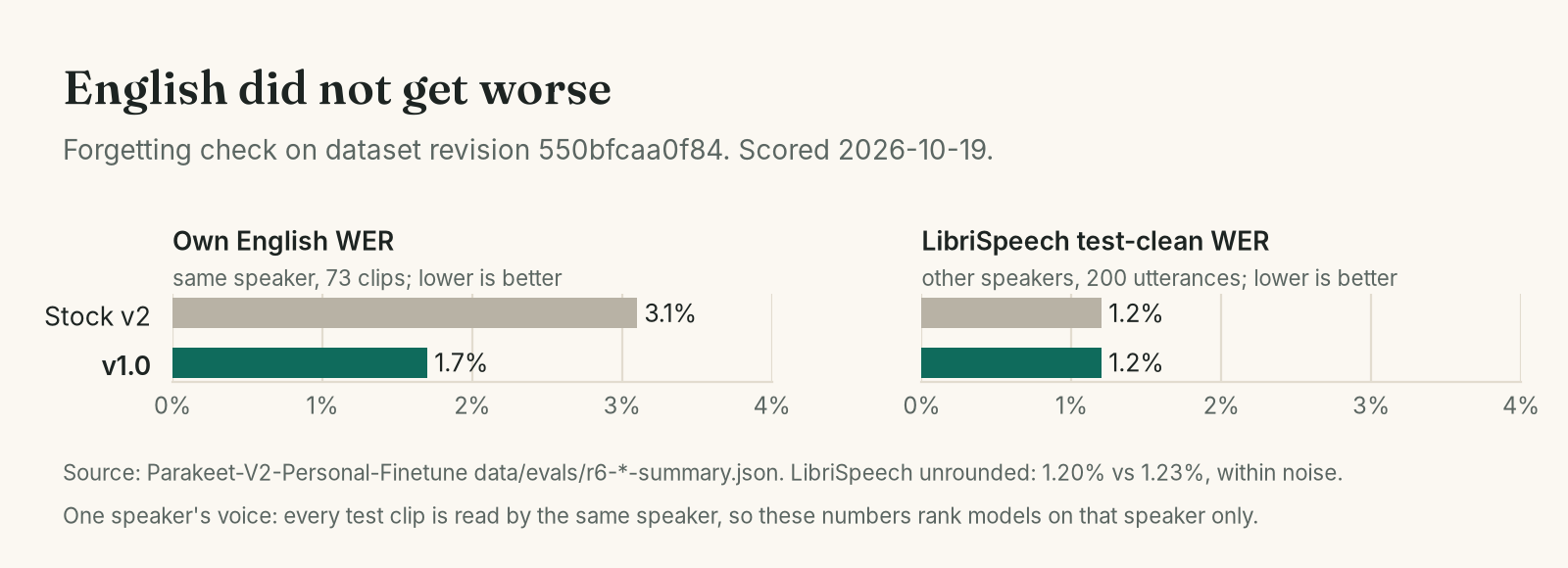
- LibriSpeech is within noise of stock, so general English was not lost.
- The checkpoints published as v1 to v5 are now PoC-1 to PoC-5; v1.0 is the first release scored on this test set.
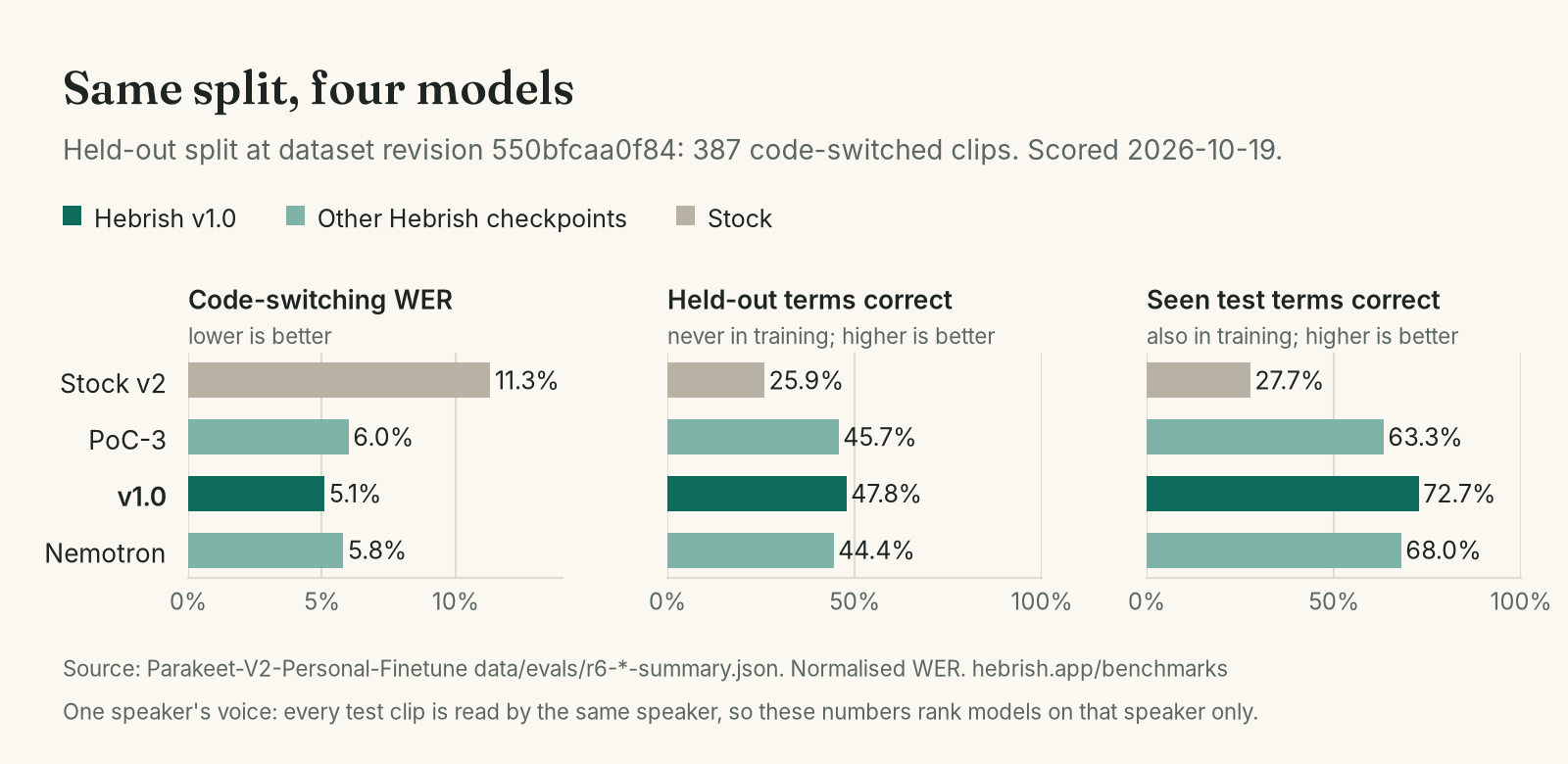
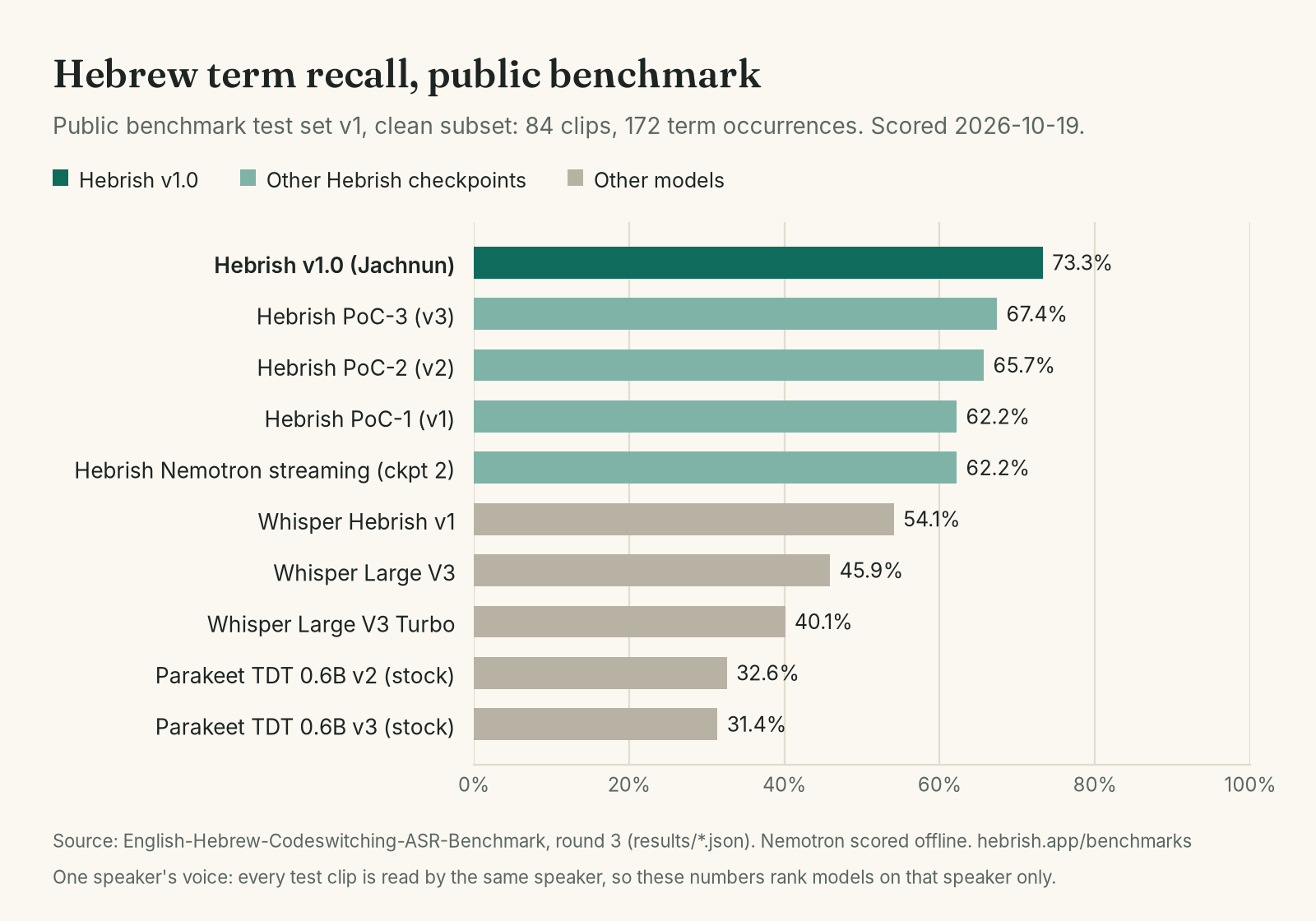
- The charts below are v1.0's earlier scoring (2026-10-19): the held-out split at dataset revision 550bfcaa0f84 and the public benchmark (test set v1, 84 clips no model trained on). The figures differ slightly from the table because the test sets differ.
Training
- v1.0 · Jachnun: 339 min of code-switched speech with a 30% English share, full fine-tune from stock v2 at dataset revision 550bfcaa0f84. AdamW, lr 3e-5, 20 epochs, batch 16; 41 minutes on one L40S; best checkpoint at epoch 18. Run name r6-en30.
- Mix: 339.2 min of code-switched speech, 95.3 min of my own plain English and 48.5 min of LibriSpeech replay, about 30% English. Fine-tuning on code-switched speech alone is known to damage a model's English; the English share limits it.
- Each release is a full fine-tune from stock v2 on all the data so far, not continued training from the previous checkpoint. Trained in NeMo; the run cost about US$0.80 on Modal.
- Before v1.0 came five proof-of-concept checkpoints, PoC-1 to PoC-5 (published as v1 to v5, 2026-10-15 to 2026-10-18), trained on 77 to 294 min of code-switching. PoC-4 and PoC-5 were never benchmarked.
Training data
Checkpoints and roadmap
Where the model is now and the checkpoints still to come. Planned stages are the current plan, not promises.
- Baseline Done 15 October 2026
Stock v2 got 28% of Hebrew term occurrences right across 615 terms.
- PoC-1 pilot (published as v1, pilot-en30) Done 15 October 2026
First release: 77 min of code-switching, 30% English. Superseded by PoC-2; kept in the Hugging Face repo history.
- GGUF export Done 15 October 2026
transcribe.cpp v0.1.3; identical transcripts to PyTorch on 5 test clips.
- PoC-2 retrain (published as v2, r2-en30) Done 15 October 2026
Released: 120 min of code-switching, 28% English, trained from stock v2. Same files and download links; .nemo plus GGUF Q8_0 and Q4_K_M.
- ONNX and sherpa-onnx export Done 16 October 2026
Separate -ONNX and -sherpa-onnx-int8 repos, for Voxtype, onnx-asr and sherpa-onnx apps.
- PoC-3 retrain (published as v3, r3-en30) Done 18 October 2026
Released: 196 min of code-switching, 27% English, trained from stock v2. Every version re-scored on a new 219-clip test split. Same download links; PoC-1 and PoC-2 pinned in the model card.
- Codeswitch Voice APK Done 18 October 2026
v0.1.0 of my own Android voice keyboard (proof of concept): sherpa-onnx int8 PoC-3 weights, on-device, companion to HeliBoard.
- Desktop dictation app Done 18 October 2026
v0.2.0 of the desktop app (Linux .deb, untested Windows build): hotkey dictation plus a Transcribe tab for recordings and audio files. The Android app moved into the same repo as v0.5.0.
- PoC-4 retrain (published as v4, r4-en30) Done 18 October 2026
Released before its benchmark: 269 min of code-switching, the first run on the 70/20/10 mix target (70.8% / 19.1% / 10.1%).
- PoC-5 retrain (published as v5, r5-en30) Done 18 October 2026
Released before its benchmark: 294 min of code-switching, 70/20/10 mix, trained early ahead of the 360-min checkpoint. .nemo, GGUF (Q8_0, Q4_K_M, F16), ONNX and sherpa-onnx refreshed; the apps pick it up on their own. MLX stays PoC-3.
- Nemotron streaming fine-tune Done 18 October 2026
Experimental second base model: the PoC-5 data and recipe on NVIDIA nemotron-speech-streaming-en-0.6b, for live streaming text. Later scored offline: 5.8% code-switching WER on the held-out split, against 5.1% for v1.0.
- Parlance Done 19 October 2026
The Android and desktop apps became Parlance (Android v0.1.0, desktop v0.1.0), with a choice of stock Parakeet or this fine-tune.
- Hebrish apps 0.2.0 Done 19 October 2026
The apps were renamed Hebrish (repo now Hebrish-ASR/Hebrish-App): Android APK, Ubuntu .deb and Windows zip, desktop hotkey F14. Parlance continues separately as a general-purpose Parakeet dictation app.
- v1.0 · Jachnun (r6-en30) Done 19 October 2026
The first release after five proof-of-concept checkpoints: 339 min of code-switching, 30% English, trained from stock v2. The checkpoints published as v1 to v5 became PoC-1 to PoC-5. MLX stays PoC-3.
- Hebrish apps: Android 0.5.0, desktop 0.2.2 Done 20 October 2026
Current app releases, linked in the downloads above. The repo was renamed Hebrish-ASR/Hebrish-App.
- Boxty v1.0 Done 20 October 2026
A sister fine-tune from the same base for English dictation without Hebrew: tech vocabulary and accent. See its own card page.
- Sabich v1.0 Done 20 October 2026
A second Hebrish model: Jachnun's data plus tech vocabulary and the other task recordings, retrained from stock v2. Level with Jachnun on code-switching; in the apps' model list. See its own card page.
- Data collection In progress
Recording continues, weighted toward terms stock v2 never gets right and terms with only one or two takes.
- v1.1 Planned
The next retrain on more code-switching audio. A comparison of 70/30, 80/20, 90/10 and 100/0 code-switching / English remains an option.
- On-phone test Planned
Measure accuracy and speed of the on-device builds on the target phone.
Limitations
- Trained on one voice so far: an English speaker with an Irish accent living in Jerusalem. Recordings from more speakers are the next step; contribute yours at hebrish.app/contact?topic=samples.
- About 5.7 hours of code-switched audio, with most Hebrew terms recorded only once or twice. Terms the model never heard in training are right only about half the time (46.9% for v1.0), and more audio has not moved that much since PoC-1.
- Spellings follow one convention (the Hebrew-Latin-Token-Classifier lexicon), so the model may prefer it over other romanizations.
- On-device accuracy and phone speed are not measured yet beyond a five-clip GGUF check.
Related
- Sabich v1.0 (the recommended Hebrish model)Jachnun's data plus tech vocabulary and other task recordings; in the same apps
- Hebrish websiteThe project site: what it does, how to install it, and the latest results
- Benchmark write-up (blog)"Can speech-to-text spell makolet?": what the benchmark measures, what it caught, and the results
- Jachnun and Sabich in depth (blog)The first stable releases: data, training recipe, results against stock Parakeet and Whisper, formats, and the white paper
- Hebrish (blog)The project: its mission, every model it has published (Jachnun, Sabich, Shakshuka, the Whisper fine-tunes) and hebrish.app
- Voice typing that understands Hebrish (blog)The apps, the models, how they were made and how Jachnun v1.0 and Sabich v1.0 score (earlier version posts are folded into it)
- Boxty v1.0 (blog)The no-Hebrew sister model, and how to choose between the two
- Shakshuka (streaming)The streaming line on NVIDIA's Nemotron base, for live text. v1.0 (2026-10-21) is trained on Sabich's data; the PoC checkpoints are at Hebrish/Nemotron-Speech-Streaming-EN-0.6B-English-Hebrew-Codeswitching
- Offline Voice InputAndroid voice keyboard that loads the GGUF